

Resources/Blogs & Articles/Cloud Strategy & Economics
Cloud Strategy & EconomicsYallaCloud Thought Leadership

The Real Cost of Public Cloud: Why Your Monthly Bill Is Hard to Predict

A cloud environment is rarely one compute charge. Here is what sits underneath the invoice — and the question to ask instead of “what is the hourly price?”
12 May 20265 min readFor CIOs, CTOs, CFOs, IT Leaders
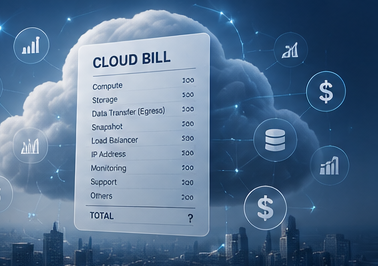
Cloud bill artwork

Cloud was supposed to make infrastructure simpler

For many organisations, public cloud delivered something transformational: infrastructure available on demand, without waiting weeks or months for hardware. But flexibility introduced a different challenge.The infrastructure may be elastic. The monthly bill can be too.

A cloud environment rarely consists of a single compute charge. The final cost can include compute, storage, snapshots, data transfer, public IP addresses, load balancers, security services, monitoring, backup, support and numerous consumption-based services.

Individually, each charge may appear reasonable. Together, they can make forecasting surprisingly difficult.

Why cloud bills become unpredictable

01Infrastructure changes continuouslyCloud environments are dynamic. Teams add virtual machines, increase storage, create snapshots, deploy databases and test new services. Even where governance exists, the infrastructure at the end of the month may look very different from the infrastructure originally budgeted.
02Data has a cost of movementMoving data between services, regions, availability zones or outside a cloud platform can create additional charges depending on the provider and architecture. For data-intensive applications, these charges can become material. The important question isn’t “how much does storage cost?” — it’s “what will it cost to store, protect, access and move this data throughout its lifecycle?”
03The VM price isn’t the infrastructure priceAn enterprise workload may also require block and object storage, backup and disaster recovery, network connectivity, firewalls and security, monitoring, load balancing, public IPs, licensing, support and managed operations. The meaningful comparison is total workload cost, not simply compute cost.
04Consumption changesPay-as-you-go works exceptionally well where workloads genuinely need elasticity. But ERP systems, databases, line-of-business applications and production platforms may run continuously for years. A predictable workload on a highly variable commercial model accepts billing complexity without gaining significant elasticity.
05Cloud cost management itself requires resourcesAs estates grow, organisations introduce FinOps processes, optimisation tools, budgets, alerts, reserved-capacity planning and specialist teams. Valuable disciplines — but they demonstrate that cloud cost has become something enterprises actively have to manage.

The question CFOs and CIOs should ask

Instead of asking“What is the hourly price?”
Ask“What will this workload cost us over the next 36 months?”

Include infrastructure, storage, network, protection, support, operations, growth assumptions and potential data movement. That produces a much more useful business comparison.

Predictability can be a cloud feature

Not every workload needs the same commercial model. Highly elastic applications may benefit enormously from consumption pricing. Stable enterprise workloads may benefit from reserved capacity or predictable monthly infrastructure models.

The future of enterprise cloud is therefore unlikely to be one pricing philosophy. It is about choosing theright economic model for each workload.

A better cloud conversation

Cloud decisions should balance:

PerformanceAvailabilitySecuritySovereigntySupportFlexibilityCost predictability

Because the best cloud isn’t necessarily the cloud with the lowest advertised hourly price. It is the cloud whose technology and economics fit the workload.

Know what your cloud will cost before you move it

YallaCloud helps organisations evaluate infrastructure requirements around workload needs, operational expectations and predictable economics.