

How to Calculate the True 3-Year TCO of Your Cloud Infrastructure
Five cost layers, one formula and three scenarios — a 36-month model that survives contact with procurement.
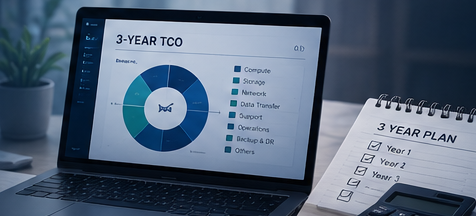
Cloud price is not cloud TCO
Cloud comparisons frequently begin with CPU, memory and storage. That’s useful — but it isn’t TCO.
A meaningful three-year cloud comparison should capture the cost ofrunning, protecting, connecting, supporting and operating the workload.
Start with the workload
Document the actual requirement:
- vCPU
- RAM
- Storage
- Expected storage growth
- Operating systems
- Databases
- Network traffic
- Backup
- Disaster recovery
- Security
- Availability
- Support
- Management
Then model that requirement for36 months.
Layer 1: Core infrastructure
Calculate:
Don’t assume today’s capacity remains constant. If storage grows 20% annually, model that growth.
Layer 2: Protection
Add:
These aren’t optional extras for most production enterprise systems. They are part of the production architecture.
Layer 3: Data movement
Understand applicable charges associated with:
- Internet traffic
- Inter-region traffic
- Inter-zone traffic
- Backup movement
- Replication
- Connectivity
The exact charging model varies between providers. The important principle is to model the expected behaviour of the application.
Layer 4: Operations
Infrastructure doesn’t operate itself. Include:
- Monitoring
- Patching
- Incident management
- Capacity management
- Security operations
- Backup management
- Cloud engineering
- Support
If these activities are performed internally, they still have a cost.
Layer 5: Migration and implementation
Include one-time expenditure:
A cheaper monthly platform can still produce a more expensive project if migration complexity is significantly higher.
Build the formula
A simplified model is:
Do not forget uncertainty
A useful financial model should include scenarios.
This exposes which pricing models transfer more financial risk to the customer.
Compare equivalent architectures
If one proposal includes backup, security, support and management while another doesn’t, normalise the comparison before making a decision.
The objective isn’t simply lower TCO
Cost matters. But enterprise infrastructure must also deliver availability, performance, security, compliance and operational resilience. The goal should therefore be:
Build your 36-month cloud model
Use YallaCloud cloud cost and TCO tools to model infrastructure beyond the headline VM price.