

Why Cloud Performance Is About More Than CPU and RAM
Two servers with identical specifications can deliver very different applications. Specifications describe capacity, not experience.
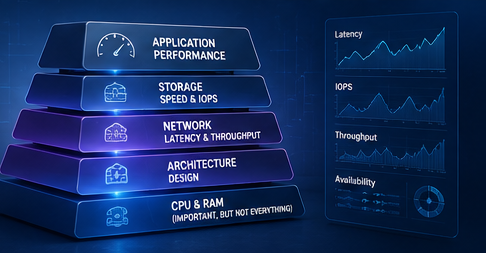
Capacity is not experience
Two cloud servers can have:
And deliver noticeably different application performance. Why? Because infrastructure specifications describecapacity. They don’t necessarily describe experience.
CPU is not just a number
“8 vCPU” doesn’t tell you everything about the underlying processor environment. Performance can be influenced by processor generation, clock characteristics, contention, virtualisation architecture and workload type.
For enterprise applications, consistent performance can be as important as theoretical peak capacity.
Storage changes everything
A database may have abundant CPU and memory but still perform poorly if storage cannot deliver the required latency or IOPS. Evaluate:
- IOPS
- Throughput
- Latency
- Storage architecture
- Consistency under load
For databases and transaction-heavy applications, storage architecture can dramatically affect the user experience.
Network architecture matters
Application performance may depend on communication between:
Latency anywhere in that path can affect the complete transaction. This is why geography matters.
Putting infrastructure closer to users and connected systems can sometimes improve application experience more effectively than adding another CPU.
Contention matters
Cloud is shared infrastructure by design. The important question is how effectively the platform manages that sharing.
Enterprises should understand whether performance remains consistent during peak infrastructure utilisation.
Architecture matters
A poorly designed 16-vCPU environment can perform worse than a well-designed 8-vCPU environment. Performance depends on the relationship between:
Operations matter too
Performance isn’t static. Applications grow, databases grow and user behaviour changes. Infrastructure that worked perfectly six months ago may eventually develop bottlenecks.
Monitoring, capacity planning and engineering remain essential. AI and automation can help identify anomalies and predict issues, but they don’t eliminate the need for skilled engineers who understand the application and infrastructure.
Measure the experience
Then measure:
- Application response time
- Database latency
- Storage latency
- Network latency
- Availability
- Resource contention
- Transaction performance
- User experience
Those metrics are much closer to the actual business outcome.
Performance is an architecture outcome
Infrastructure specifications matter. But they are ingredients, not the finished product. Great cloud performance comes from designing compute, storage, network, security and operations around the workload.
Because ultimately:customers don’t experience CPU and RAM — they experience the application.
Design cloud around application experience
YallaCloud combines infrastructure, regional architecture and human cloud expertise to build environments around application performance requirements.