

Modernising Legacy Applications Without Rebuilding Everything
Rebuild is one option, not the default. Most constraints can be removed around the application — access, security, infrastructure — at far lower risk.
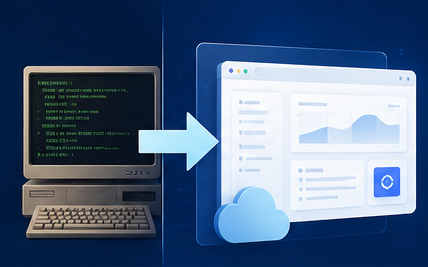
Modernisation does not mean starting over
Digital transformation often creates an uncomfortable assumption:to modernise, we need to rebuild the application. Sometimes that is the right answer. Often it isn’t.
Many enterprises depend on applications developed years ago that continue to perform important business functions. Replacing them can introduce cost, complexity and risk without necessarily creating proportional business value. The better question is:
Modernisation isn’t one thing
There are several levels of application modernisation — and they are very different projects.
Why rebuilding isn’t always the answer
A legacy application may contain years of:
- Business logic
- Integrations
- Custom workflows
- Historical data
- User knowledge
- Regulatory requirements
Replacing it can mean rediscovering and recreating all of that complexity. If the business problem is simply that the application is difficult to access, poorly protected or running on ageing infrastructure, a complete rebuild may be unnecessary.
Modernise the experience first
Sometimes the application itself can remain largely unchanged while the surrounding experience is modernised. For example:
Users gain simpler, more secure access without requiring the organisation to immediately rewrite the application.
Modernise the infrastructure
Applications running on ageing hardware can often be moved to:
- Virtualised infrastructure
- Private cloud
- Regional cloud
- Managed cloud
This can improve resilience, backup, DR, monitoring and operational support without materially changing the application.
Modernise security
Legacy applications may not have been designed for today’s security requirements. The surrounding architecture can introduce:
- MFA
- Identity integration
- Web application protection
- Endpoint security
- Network segmentation
- Secure remote access
- Monitoring
- Continuous compliance
Modernisation can therefore happenaround the application.
Modernise progressively
This reduces transformation risk. It also allows investment to follow business value.
Decide based on business outcome
Ask:
- 01Is the application still functionally valuable?
- 02Is infrastructure the main constraint?
- 03Is user access the problem?
- 04Is security the problem?
- 05Is scalability the problem?
- 06Does the application require new integrations?
- 07What would rebuilding actually improve?
If the application continues to serve the business well, modernising its environment may deliver more value than replacing it.
Transformation doesn’t have to begin with replacement
Modernisation should remove constraints. Sometimes that requires new software. Sometimes it simply requires a better way torun, secure, access and manage the software you already have.
Modernise at the pace your business needs
YallaCloud helps organisations modernise legacy applications through cloud infrastructure, secure application delivery, business continuity and managed operations.