

Building AI Infrastructure: GPU Cloud vs Dedicated GPU Environments
Buying GPUs isn’t the only option. Utilisation, data architecture and sovereignty decide whether cloud or dedicated capacity fits.
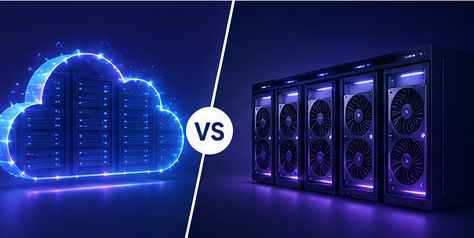
A new enterprise architecture decision
AI infrastructure has quickly become a new enterprise architecture decision. Organisations experimenting with generative AI, machine learning, inference and model training increasingly need access to GPU computing.
But buying GPUs isn’t the only option. Enterprises can consume GPU capacity through cloud platforms or deploy dedicated GPU infrastructure. The right answer depends on the workload.
GPU Cloud
GPU cloud provides accelerator capacity as a service. Instead of purchasing physical GPU infrastructure, organisations consume available resources from a provider. Strong fit:
- AI experimentation
- Proofs of concept
- Short-term projects
- Variable demand
- Rapid deployment
- Teams entering AI for the first time
The principal advantage is flexibility. Infrastructure can be accessed without committing immediately to substantial hardware investment.
Dedicated GPU environments
Dedicated environments allocate GPU infrastructure to a specific organisation or workload. This can provide greater control over:
- Capacity
- Performance
- Network architecture
- Storage
- Security
- Data
- Platform configuration
For sustained AI workloads, dedicated infrastructure may also produce a different long-term economic model.
Utilisation changes the economics
Consider a GPU required for several hours each week — cloud consumption may be highly efficient. Now consider GPUs operating at high utilisation continuously for three years. The economics can change considerably.
Don’t forget the rest of the architecture
AI infrastructure isn’t just GPUs. A production environment may require:
Feeding data to accelerators efficiently can be as important as the accelerator itself. Poor storage or network architecture can leave expensive GPUs waiting for data.
Training and inference are different
Training large models can require significant accelerator capacity for concentrated periods. Inference may operate continuously with very different performance characteristics.
Organisations should therefore avoid designing all AI infrastructure around a single workload pattern.
Sovereignty matters for AI too
Enterprise AI often interacts with valuable organisational data. Architecture discussions should therefore consider:
- Where data is stored
- Where models operate
- Who can access infrastructure
- How data is protected
- Where inference occurs
- Whether information crosses jurisdictions
AI strategy and data-governance strategy increasingly need to align.
A hybrid approach can make sense
This allows infrastructure commitment to increase as AI workloads mature.
Start with the workload, not the GPU
Before selecting infrastructure, understand:
Then choose the GPU architecture. Because the objective isn’t to own the most powerful accelerator. It is to deliver the AI workload efficiently.
Build infrastructure for your AI workload
YallaCloud provides GPU cloud and AI infrastructure options designed around workload performance, data requirements and enterprise control.