

Sovereign Cloud Explained: What It Actually Means for Middle East Enterprises
Data location is where sovereignty starts, not where it ends. Five dimensions decide whether your organisation actually holds control.
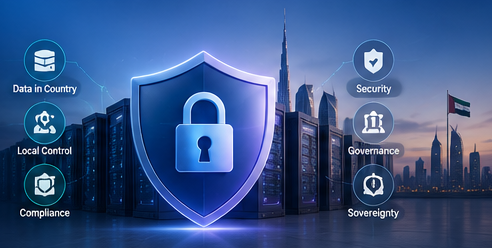
Sovereignty goes beyond geography
“Sovereign cloud” has become one of the industry’s most frequently used terms. It is also one of the most misunderstood.
Keeping data inside a country’s borders can be important, but data location alone does not necessarily create sovereignty. For Middle East enterprises, understanding that distinction is increasingly important.
The dimensions of sovereignty
A sovereign-cloud strategy can involve several dimensions.
True sovereignty therefore isn’t simply “where is my server?”It is also:
Why this matters in the Middle East
Across the region, governments and regulated industries are increasing their focus on data governance, cybersecurity, localisation and operational resilience.
Requirements differ by country and industry, so enterprises should evaluate the regulations applicable to their specific organisation and workload. But the strategic direction is clear:
Sovereign does not necessarily mean isolated
A common misconception is that sovereignty requires disconnected infrastructure. It doesn’t. A sovereign environment can still provide modern cloud capabilities while maintaining clearly defined control boundaries.
The architecture can support all of these while applying stronger governance to where infrastructure operates and who controls it.
Questions to ask
When evaluating a sovereign-cloud proposition, ask:
- Where is primary data stored?
- Where are backups stored?
- Where is data processed?
- Who operates the infrastructure?
- Who has privileged administrative access?
- Where are encryption keys controlled?
- Which jurisdiction governs the contract?
- Which third parties can access the environment?
- Can workloads be migrated?
- How is compliance continuously demonstrated?
Those answers provide far more insight than a “sovereign cloud” label.
Sovereignty should be designed
Sovereignty works best when it is treated as part of architecture from the beginning. Identity, infrastructure, data, security, operations and governance should work together.
For CIOs and CISOs, that creates an important principle:
Build cloud around your control requirements
YallaCloud enables organisations to explore regional and sovereign cloud architectures aligned with workload, governance and operational requirements.