

Data Residency vs Data Sovereignty: What CIOs Need to Know
One question asks where the data sits. The other asks whose authority reaches it. The difference shapes architecture, procurement and compliance.
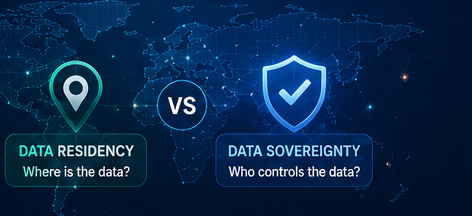
Two terms that should not be confused
Data residency and data sovereignty are often used interchangeably. They shouldn’t be.
For organisations operating across multiple jurisdictions, understanding the difference can influence cloud architecture, security, procurement and compliance.
Data residency asks “where?”
Data residency generally concerns the physical or geographic location where information is stored or processed. For example:
This is fundamentally a location question.
Data sovereignty asks “under whose authority?”
Data sovereignty considers the laws and governance frameworks applicable to the data. Location can influence this, but sovereignty introduces broader questions involving ownership, control, access and jurisdiction. A better question becomes:
Why the distinction matters
Imagine an organisation stores its data within its home country. Its residency requirement may appear satisfied. But consider:
- Who operates the service?
- Which legal entity contracts with the customer?
- Who controls privileged access?
- Where are backups located?
- Who controls encryption keys?
- Which subprocessors participate?
- Which jurisdictions could potentially apply?
The architecture may therefore satisfy a location requirement without satisfying every sovereignty objective.
Add operational sovereignty
There is another dimension CIOs should consider:who can actually operate the environment?Privileged administrators can have significant technical authority.
Organisations dealing with sensitive workloads should therefore understand administrative access, identity governance, logging, key management and operational processes.
Build a data-control map
For every critical workload, document:
This simple exercise can reveal dependencies that aren’t obvious from an infrastructure diagram.
The CIO checklist
Before approving a cloud architecture, understand:
- 01Where production data resides.
- 02Where backups and replicas reside.
- 03Where data is processed.
- 04Which entity provides the service.
- 05Who can administer the environment.
- 06Who controls encryption keys.
- 07Which third parties are involved.
- 08How data can be retrieved or migrated.
- 09Which compliance requirements apply.
The objective isn’t to eliminate every external dependency. It is to understand and consciously govern them.
Location is only the beginning
Data residency answers an important question. Data sovereignty answers a bigger one.
As regional cloud regulation and governance requirements evolve, enterprise cloud decisions increasingly need to address both.
Understand where your data lives — and who controls it
Explore YallaCloud architectures designed around regional infrastructure, governance and enterprise control.